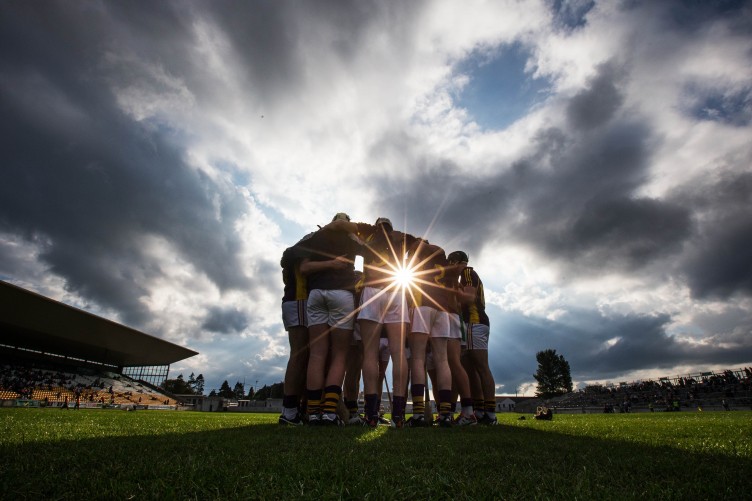

Hurling vs Gaelic football is the first question almost every new fan asks once they discover Ireland's native games: are they the same sport with different equipment, or two completely different worlds? The short answer is that they are siblings. They share a governing body, a pitch, goalposts and a scoring system, but one is played with a ball at your feet and in your hands, and the other with a wooden stick and a small leather ball that can travel faster than almost anything else in field sports.
Key Takeaways
- Hurling and Gaelic football are both governed by the Gaelic Athletic Association (GAA), founded in 1884, and both are played 15-a-side on the same size pitch with the same H-shaped goalposts.
- Hurling is far older: stick-and-ball games appear in Irish law tracts from the seventh century, while modern Gaelic football rules were drawn up in 1884 and published in 1887.
- Hurlers use a hurley (camán) and a sliotar, and helmets with face guards have been compulsory at every level since January 1, 2010.
- The women's versions are camogie (hurling) and ladies' Gaelic football, each run by its own association, and the top men's prizes are the Sam Maguire Cup (football) and the Liam MacCarthy Cup (hurling).
- Most American beginners find Gaelic football easier to pick up quickly, which is why our club is built around it, but anyone can learn either game with patience.
Two Games, One Family: The GAA
Both hurling and Gaelic football sit under the same umbrella: the Gaelic Athletic Association, known in Ireland simply as "the GAA." The Association was founded on November 1, 1884, at a meeting in Hayes Hotel in Thurles, County Tipperary, called at the urging of Michael Cusack. Its goal was to preserve and organize the native sports of Ireland at a time when English games were spreading quickly.
That shared origin explains why the two sports feel so connected. Clubs in Ireland often field teams in both codes, and the national championships in each sport reach their climax at Croke Park in Dublin. You can read more about the Association itself on the official GAA website.
For a new American fan, think of it this way: Gaelic football looks a little like soccer, rugby and basketball mixed together, while hurling looks like lacrosse, field hockey and baseball played at full speed. If you are brand new to the football side, our primer on what Gaelic football is is a great place to start.
Origins: How Old Are Hurling and Gaelic Football?
Hurling's ancient roots
Hurling has a strong claim to being one of the oldest field games in the world. Stick-and-ball games known in Irish as iomáin and báire appear in Irish law tracts dating from the seventh century, as well as in early annals and poetry. Archaeological evidence of the game dates back to the twelfth century, and the English word "horlinge" turns up in the Statute of Kilkenny in 1366, a law that tried (and failed) to stop settlers from adopting Irish customs, including the game.
Gaelic football's roots
Football-style games have also been played in Ireland for centuries. The first legal reference to football in Ireland dates from 1308, and a recorded match in County Meath in 1670 allowed both catching and kicking the ball, which sounds a lot like the modern game. In County Kerry, a rough-and-tumble version called caid was popular in the early 1800s.
What turned these local traditions into a national sport was the GAA. Maurice Davin, the Association's first president, drew up a set of rules in 1884, and they were published in 1887, the same year the first All-Ireland Senior Football Championship was played. In other words, hurling is ancient, while Gaelic football as we know it is a codified, modern sport built on older folk games. Our separate guide to Gaelic football rules walks through today's version in detail.
"Ní neart go cur le chéile." (There is no strength without unity.)
Traditional Irish proverb
Equipment: Hurley, Sliotar and Helmet vs a Round Ball
What hurlers carry
The defining piece of hurling equipment is the hurley, called a camán in Irish (you may also hear "hurl" or "stick"). It is traditionally carved from ash, with a flat, curved blade called the bas, and players choose a length that suits their height and position.
The ball is the sliotar: a small, hard ball with a cork core, a leather cover and raised stitching. It is roughly the size of a baseball, and a well-struck sliotar travels huge distances, which is exactly why protection matters.
Helmets with face guards are now compulsory. According to the GAA, the rule was first introduced at underage level and then extended to hurlers at all levels from January 1, 2010. Helmets must meet the Irish safety standard IS:355 (or a replacement standard set by Ireland's national standards authority), and the GAA warns players not to modify the faceguard or remove bars, since altered helmets lose their protection and their insurance coverage.
What Gaelic footballers carry
Gaelic football is much simpler from a gear standpoint. You need a round leather ball (similar in size to a soccer ball but heavier, with 18 stitched panels), a pair of cleats, shin guards if you want them and a mouthguard, which the GAA made mandatory at adult level in 2014. That low barrier to entry is one reason football is usually the first Gaelic game newcomers try. Our Gaelic football gear guide covers everything you need for a first season.
Tip for newcomers: Don't rush out and buy a hurley first. The right length depends on your height and position, so borrow a stick at a first session and let an experienced player help you choose. And always wear a certified helmet, even in a casual puck-around.
Ball Handling Rules in Each Sport
This is where the two sports really diverge. Both limit how long you can hold the ball, but the methods are completely different.
Handling in Gaelic football
- Catching: You can catch the ball cleanly in your hands, including spectacular high catches over opponents.
- Carrying: You can take up to four steps while holding the ball. After that you must bounce it, "solo" it (drop it onto your foot and kick it back into your hands), pass it or shoot.
- Bouncing: You can't bounce the ball twice in a row, but you can solo as many times as you like, alternating with a single bounce.
- Picking up: In the men's game, you can't pick the ball straight off the ground with your hands. You have to lift it with your foot (a "toe pick-up").
- Passing: You can kick the ball or hand-pass it with a clear striking motion. Throwing is a foul.
Handling in hurling
- Catching: You can catch the sliotar in your hand, and most players catch it in their free hand, often with the hurley held up for protection.
- Carrying in the hand: You can take no more than four steps with the sliotar in your hand.
- Carrying on the hurley: You can carry the sliotar on the bas of the hurley as far as you like, either balancing it or bouncing it as you run. This is the hurling "solo."
- Picking up: You can't pick the sliotar straight off the ground with your hand. You have to lift it with the hurley first.
- Limits: You can only handle the ball twice in one possession before it touches the ground or the hurley again, and you can't throw it. You can strike it with the hurley, kick it or slap it away with an open hand.
In practice, Gaelic football rewards catching and kicking accuracy, while hurling rewards hand-eye coordination and wrist work. Both reward serious fitness.
The Shared Pitch and Scoring System
Once you understand scoring in one game, you understand it in the other. Both are played on a grass pitch roughly 130 to 145 meters long and 80 to 90 meters wide, with H-shaped goalposts: a soccer-style net below the crossbar and tall uprights above it.
- A goal (ball into the net under the crossbar) is worth 3 points.
- A point (ball over the crossbar between the uprights) is worth 1 point.
Scores are written as goals and points. A team showing 2-11 has scored two goals and eleven points, for a total of 17. If the other team has 1-15 (18 points), they win despite scoring fewer goals.
There is one recent wrinkle. Under the GAA's revised Gaelic football rules, introduced for the 2025 season, a score kicked over the bar from outside a 40-meter arc is now worth two points in men's football. Hurling has not adopted a scoring arc, so the basic goal-equals-three, point-equals-one system remains the foundation of both games.
Hurling vs Gaelic football at a glance
| Feature | Hurling | Gaelic Football |
|---|---|---|
| Earliest roots | Written references in seventh-century Irish law tracts | Folk football recorded from 1308; GAA rules published 1887 |
| Governing body | GAA | GAA |
| Players per side | 15 | 15 |
| Ball | Sliotar: small, cork core, leather cover | Round leather ball with 18 panels |
| Main equipment | Hurley (camán), helmet with face guard | Cleats, mouthguard |
| Mandatory protection (adults) | Helmet with face guard (all levels since 2010) | Mouthguard (adult level since 2014) |
| Carrying the ball | Four steps in hand; unlimited on the hurley | Four steps, then bounce or solo |
| Picking up off the ground | Must lift with the hurley | Must lift with the foot (men's game) |
| Scoring | Goal = 3, point = 1 | Goal = 3, point = 1, plus 2-point scores from outside the arc (men's game) |
| Women's version | Camogie | Ladies' Gaelic football |
| Top men's trophy | Liam MacCarthy Cup | Sam Maguire Cup |
| Beginner learning curve | Steeper: stick skills take time | Gentler: most athletes can play in a few sessions |
Camogie and Ladies' Gaelic Football
Women play both codes, each with its own governing association.
Camogie
Camogie is the women's version of hurling, and it is run by the Camogie Association, which was founded in 1904. That gives the women's stick game well over a century of organized history. The first All-Ireland senior camogie championship was played in 1932, when Dublin defeated Galway, and the winners receive the O'Duffy Cup, named after Seán O'Duffy, who donated the original trophy. The rules are very close to hurling, with a few differences, and the speed and skill on show are every bit as impressive. You can learn more from the Camogie Association.
Ladies' Gaelic football
Ladies' Gaelic football is governed by the Ladies' Gaelic Football Association (LGFA), which was founded in 1974. The first All-Ireland senior championship was also played that year and won by Tipperary, and today's senior champions lift the Brendan Martin Cup. The game is very similar to the men's version, but there are some notable differences: for example, players can pick the ball directly off the ground with their hands, and from under-12 level upward the game uses a slightly smaller size 4 ball. The LGFA's website has the full rules.
Ladies' football has a proud place in our own story. Our club began fielding a ladies' football team at the West Coast 7s in San Diego in 2017, and we always welcome women who want to try the game, whether they have played before or not.
The Sam Maguire and Liam MacCarthy Cups
Gaelic games have two famous trophies, and both have a surprising connection to London.
The Sam Maguire Cup (football)
The Sam Maguire Cup is awarded to the winners of the All-Ireland Senior Football Championship. It was first presented in 1928, when Kildare beat Cavan by a single point in the final. The cup commemorates Sam Maguire, a former footballer and an influential figure in the London GAA. The original trophy was retired in 1988 after years of wear, and a replica made by a Kilkenny silversmith has been presented ever since. Fans often simply call it "Sam," and you'll hear Irish supporters talk about "bringing Sam home."
The Liam MacCarthy Cup (hurling)
The Liam MacCarthy Cup goes to the All-Ireland Senior Hurling champions. It was first presented in 1923 to Limerick, the winners of the 1921 championship, whose final had been delayed until March 1923 because of the political situation in Ireland. Liam MacCarthy was born in London in 1853 to Irish parents and was heavily involved in setting up a GAA county board in London in the 1890s.
That London connection is a reminder that the games have always traveled with the Irish diaspora. Our article on Gaelic games in North America picks up that story on this side of the Atlantic.
Which Is Easier for Beginners and Americans?
The honest answer depends on your sporting background, but there are some clear patterns.
Why Gaelic football is usually easier to start
- Familiar skills: If you have played soccer, basketball, rugby or American football, you already have most of the building blocks: catching, kicking and reading space.
- Less equipment: Cleats and a mouthguard are enough to get started.
- Faster to contribute: Most athletic adults can play a useful role in a match within a few weeks.
Why hurling takes longer
- Stick skills are new: Striking off both sides and lifting the sliotar with the hurley are skills most adults have never practiced.
- Speed: As the old saying goes, hurling is "the fastest game on grass," and reading the ball's flight takes time.
- Background helps: Lacrosse, hockey and baseball players often adapt faster thanks to their stick or bat skills.
Our club's own history reflects this. When our founders started the club in 1979 at the Christian Brothers of St. Patrick's in Huntington Beach, hurling was tried first, but the group decided to continue as a football club. Over the years we have also fielded men's hurling at times, alongside men's and ladies' football.
How to Try Both in Southern California
Our catchment area runs from Orange County up toward Los Angeles, and there are Gaelic games clubs across the region and down in San Diego.
- Start with football at our club. We have traditionally trained on Wednesdays at 6:30 pm and Saturdays at 9:00 am. Check our training page for the latest times and location.
- Watch some hurling. The San Diego / West Coast 7s on Memorial Day weekend features both football and hurling, so it's a great day to see the two side by side.
- Ask about hurling. If the stick game grabs you, talk to us and we'll point you toward the wider Southern California hurling community.
Ready to try Gaelic games in Orange County?
Whether you're drawn to the catch-and-kick of football or curious about the speed of hurling, the Wild Geese welcome complete beginners. Reach out, come to a training session and see for yourself.
Get in TouchFrequently Asked Questions
Is hurling the same as Gaelic football?
No. Both are Gaelic games governed by the GAA and both are played 15-a-side on the same pitch with the same scoring system, but hurling is played with a wooden stick (hurley) and a small leather ball (sliotar), while Gaelic football is played with a round ball using the hands and feet.
Which is older, hurling or Gaelic football?
Hurling is much older. Stick-and-ball games appear in Irish law tracts from the seventh century. Folk football was also played in Ireland for centuries, but the modern rules of Gaelic football were drawn up by the GAA in 1884 and published in 1887.
Do hurlers have to wear helmets?
Yes. The GAA made helmets with face guards compulsory for hurlers at all levels from January 1, 2010, and they must meet the IS:355 safety standard. Gaelic footballers don't wear helmets, but mouthguards are mandatory.
What is camogie?
Camogie is the women's version of hurling. It is governed by the Camogie Association, founded in 1904, and the All-Ireland senior champions receive the O'Duffy Cup. The women's version of Gaelic football is ladies' Gaelic football, run by the LGFA.
Is Gaelic football or hurling easier for Americans to learn?
Most American beginners find Gaelic football easier to start because it uses familiar skills like catching, kicking and running with the ball. Hurling takes longer to learn because the stick skills are new to most adults, although players with lacrosse, hockey or baseball experience often adapt quickly.
Can I play hurling or Gaelic football in Orange County?
Yes. The Wild Geese GFC is based in Orange County and welcomes beginners to Gaelic football training. Contact us and we can also point you toward the wider Southern California hurling community.
Wild Geese GFC Editorial Team
Written by the players and volunteers of Wild Geese Gaelic Football Club, Orange County’s GAA club since 1979. Questions or corrections? Contact us.