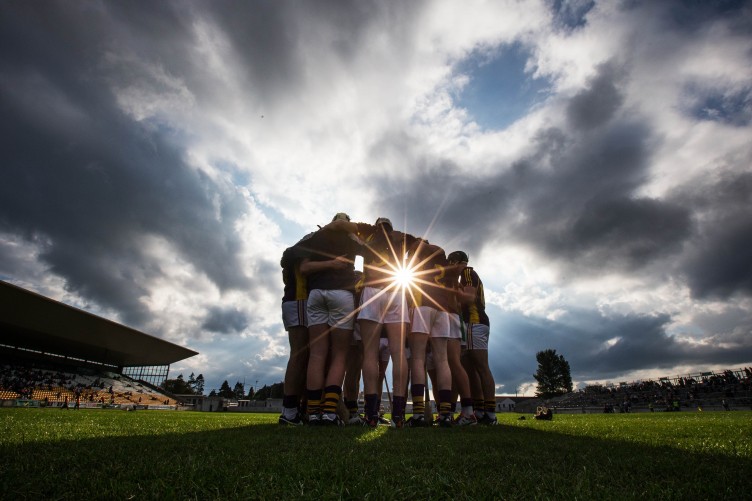
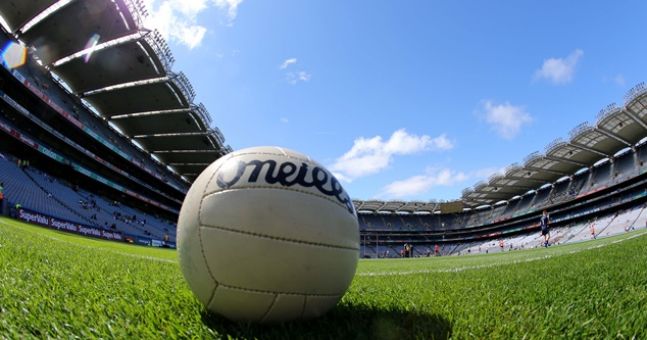
Gaelic football is fast, physical and surprisingly easy to follow once someone walks you through the basics. This beginner's guide to Gaelic football rules covers everything a new player or spectator needs, from the pitch and the scoring system to tackling, cards and the major rule changes the GAA introduced in 2025. Read it once, then come and see it in action at one of our sessions in Orange County.
Key Takeaways
- Gaelic football is played 15-a-side on a large grass pitch with H-shaped goalposts; US tournaments often use a 7-a-side format on a smaller field.
- A goal (under the crossbar) is worth 3 points and a point (over the crossbar) is worth 1, so a score of 3-11 equals 20 points.
- You can carry the ball for up to four steps before you must bounce it, solo it (toe-tap it back to your hands) or release it, and you can't bounce it twice in a row.
- Passing with the hand must be a striking motion (a handpass); throwing the ball is a foul.
- Since 2025, kicks from outside a new 40-meter arc are worth two points, and kick-outs, throw-ins and team shape are all covered by new rules.
What Is Gaelic Football?
Gaelic football is one of the national games of Ireland, governed by the Gaelic Athletic Association (GAA). If you have never seen it, the easiest way to picture it is as a blend of soccer, basketball and rugby: you can kick the ball, catch it, carry it and pass it with your hand, and you score by putting the ball into a net or over a crossbar. It is fully amateur and played everywhere from small Irish villages to clubs like ours in Southern California.
If you want the big-picture introduction first, our What Is Gaelic Football? FAQ is a good place to start. This article goes a level deeper into the actual rules.
The Pitch, the Teams and Game Length
Pitch dimensions and markings
A full-size Gaelic football pitch is a grass rectangle 130 to 145 meters long and 80 to 90 meters wide, which is considerably bigger than an American football field. Lines are marked across the field at 13 meters, 20 meters and 45 meters from each end line, plus a halfway line. In front of each goal there are two rectangles: a small rectangle (where the goalkeeper has special protection) and a large rectangle (which defines the area for penalties). Since 2025 there is also a 40-meter arc at each end, which we explain in the rule-changes section below.
The goalposts
The goals are H-shaped: two posts 6.5 meters apart with a crossbar 2.5 meters off the ground and a net below the bar. The posts extend upward well above the crossbar, giving a large target for points.
Team size: 15-a-side and 7-a-side
The traditional game is 15-a-side: a goalkeeper, six defenders (full-back line and half-back line), two midfielders and six forwards (half-forward line and full-forward line). Teams can also use substitutes during the game.
In the United States, where clubs often have smaller squads, you'll also see 7-a-side tournaments played on a shorter, narrower pitch with shorter halves. Tournament organizers set the exact format, but the core skills and scoring stay the same. Over a season our club plays local cup games such as the Southland Cup against the Culver City Cougars as well as tournaments like the San Diego / West Coast 7s over Memorial Day weekend. You can find upcoming fixtures on our schedule page.
Game length and officials
Senior inter-county games in Ireland last 70 minutes (two halves of 35 minutes). Most adult club games are 60 minutes (two halves of 30), and 7-a-side tournament games are much shorter so teams can play several matches in a day. The referee adds stoppage time, and drawn knockout games may go to extra time.
A game is controlled by a referee, two linesmen and four umpires (two at each set of posts) who signal scores with flags.
Scoring: Goals, Points and Two-Pointers
- Goal (3 points): the ball goes under the crossbar and into the net. Goals generally have to be kicked; a handpassed goal is not allowed. The umpire raises a green flag.
- Point (1 point): the ball goes over the crossbar between the posts, whether kicked or fisted. The umpire raises a white flag.
- Two-point score (2 points): since 2025, a kick that goes over the bar from on or outside the 40-meter arc counts double. At inter-county level the umpire waves an orange flag.
How to read a Gaelic football score
Scores are written as goals, then points: 3-11 means three goals and eleven points. To get the total, multiply the goals by three and add the points: 3 × 3 + 11 = 20. Two-point scores are simply added into the points column, so a team with two goals and three two-pointers among its points still writes its score the same way.
Here's a real example from our own history. In the 2016 Southland Cup Final, the Wild Geese beat the LA Cougars 3-11 to 2-10. That works out to 20 points to 16, a four-point win.
| Score type | How it's scored | Value | Umpire signal |
|---|---|---|---|
| Goal | Ball kicked under the crossbar into the net (no handpassed goals) | 3 points | Green flag |
| Point | Ball kicked or fisted over the crossbar between the posts from inside the 40m arc | 1 point | White flag |
| Two-point score | Ball kicked over the bar from on or outside the 40m arc, from play or a free | 2 points | Orange flag (inter-county) |
| 45 (converted) | Kick from the 45m line after a defender puts the ball over their own end line | 1 point | White flag |
| Penalty (converted) | Shot at goal from the penalty spot after certain fouls in or around the large rectangle | 3 points | Green flag |
Spectator tip: When you see a score like "1-14 to 0-17," don't assume the team with more points is winning. Convert first: 1-14 is 17 and 0-17 is 17, so that game is level.
Handling the Ball: Steps, Solo and Bounce
This is where most beginners give away their first free.
The four-step rule
When you're holding the ball, you can take up to four steps. Before or on that fourth step you must do one of three things: bounce the ball, solo it, or get rid of it with a kick or handpass. Taking a fifth step is called "overcarrying" and gives the other team a free.
The solo
The solo is the signature skill of the game. While running, you drop the ball onto your foot and tap it back up into your hands with your toe. A solo "resets" your steps, so you can keep running with the ball by soloing every four steps. You can solo as many times in a row as you like.
The bounce rule
You can also bounce the ball off the ground, like a basketball dribble, but you can't bounce it twice in a row. After a bounce, your next move must be a solo, a pass or a shot. Most players alternate: bounce, solo, solo, bounce, and so on.
Picking the ball up
In men's Gaelic football you may not pick the ball directly off the ground with your hands. Instead you scoop it up with your foot (the "pick-up" or toe-lift). Ladies' Gaelic football allows players to pick the ball up directly, one of several differences explained by the Ladies Gaelic Football Association.
Passing, Tackling and Physical Contact
Handpass vs. throwing
You can pass the ball by kicking it or by handpassing it. A legal handpass is a clear striking motion: you hold the ball in one hand and punch or slap it away with the other. Simply throwing the ball, the way you would in basketball or American football, is a foul. Referees watch closely for this, especially on quick, short passes in traffic.
The tackle
Tackling in Gaelic football is about winning the ball, not taking down the player. You are allowed to:
- Knock or slap the ball out of an opponent's hands with an open hand.
- Block a kick or handpass (but not with your foot).
- Make a fair side-to-side shoulder challenge when the opponent is in possession or playing the ball.
You are not allowed to pull, push, trip, hold or wrestle an opponent, grab the ball out of their hands, slide tackle, or make contact with the goalkeeper inside the small rectangle.
The shoulder charge
The legal shoulder charge is shoulder-to-shoulder, with at least one foot on the ground, while the opponent has the ball or is about to play it. A charge into the back or chest, or one that leaves your feet, is a foul. For newcomers, especially those used to rugby or American football, this is the area that takes the most practice. We cover safe technique at training on our training page.
Fouls, Frees and Cards
Most fouls are punished with a free kick to the other team from where the foul happened. Kickable frees within range are often taken as shots at the posts, and since 2025 a free taken from outside the arc and kicked over the bar is worth two points.
The card system
Referees in Gaelic football use three colors of card:
- Yellow card: a caution for an aggressive or reckless foul or for dissent. Two yellows equal a red.
- Black card: introduced in 2014 for cynical fouls such as deliberately pulling down an opponent, tripping, or body-checking to stop an attack. Since 2020, a black card means 10 minutes in the sin bin, and the team plays short during that time.
- Red card: a sending-off for serious foul play (such as striking or kicking an opponent, or a second yellow). The player cannot be replaced.
Advantage, dissent and the 50-meter penalty
Referees can play advantage when the fouled team is still in a good position. Since 2025, dissent toward the referee or deliberately delaying an opponent's free can see the ball moved forward 50 meters (as far as the 13-meter line). Only the captain is supposed to speak with the referee about decisions.
Kick-Outs, Throw-Ins, 45s and the Mark
Kick-outs
After a score or a wide, the goalkeeper restarts play with a kick-out. Under the 2025 rules, the kick-out is taken from the 20-meter line and must travel beyond the 40-meter arc. Opponents may stand inside the 20-meter line but must be at least 13 meters from the ball. A clean catch from a long kick-out can earn the catcher a mark (see below).
The throw-in
Each half starts with the referee throwing the ball up at midfield. Since 2025, only one player from each team contests it, while the other midfielders wait on the halfway line by the sidelines.
The 45
If a defender sends the ball over their own end line, the attacking team gets a "45": a free kick from the 45-meter line in line with where the ball went out. A converted 45 is worth one point, even though it's taken from beyond the arc.
The mark
The mark rewards high catching. When a player makes a clean catch from a qualifying kick, they can claim a mark and take a free kick from that spot, or play on. Under the 2025 rules, the "advanced mark" applies when an attacker catches the ball cleanly inside the opponents' 20-meter line from a kick that came from outside the 45-meter line. The catcher can play on, and if no advantage results, the referee brings play back for the free.
The 2025 Rule Changes Explained
In 2024, the GAA's Football Review Committee (FRC), chaired by former Dublin manager Jim Gavin, proposed a package of changes designed to make the game more open and attacking. A Special Congress in late November 2024 approved them on a trial basis for the 2025 season at both club and inter-county level. After some in-season amendments, a second Special Congress at Croke Park on October 4, 2025 voted to make the rules permanent, with further tweaks taking effect for 2026. Full details are published on the official GAA website.
The main changes are:
- The two-point score. A 40-meter arc is marked at each end, starting from the 20-meter line. A kick over the bar from on or outside the arc, from play or from a free, is worth two points. From 2026, the shot keeps its two-point value unless a teammate of the shooter touches it on the way. A goal stays at three points; a proposal for a four-point goal was dropped before the vote.
- Kick-out changes. Kick-outs go from the 20-meter line and must travel beyond the 40-meter arc, which encourages contested high catching instead of short, safe restarts.
- Three up, three back. Teams must keep a minimum number of players on each side of the halfway line, originally at least three outfield players in each half. In 2025 this was adjusted so that a team keeps at least three outfield players in the opposition half and four players (which can include the goalkeeper) in its own half. Breaking the rule concedes a free. The aim is to stop mass defensive "blankets."
- Solo and go. A fouled player can play on immediately with a quick tap to themselves instead of waiting to take a set free, and can't be tackled for the first few meters.
- Goalkeeper restrictions. Back passes to the goalkeeper are limited, so teams can't simply recycle possession through their keeper.
- The 1-v-1 throw-in. Only one player per team contests the throw-in at the start of each half.
- Clock and hooter. Where facilities allow, a public clock and hooter signal the end of each half.
- Tougher sanctions. Dissent and deliberate delays move frees forward 50 meters, and from 2026 pulling an opponent's jersey to deny a goal-scoring chance brings a black card and a penalty.
Some of these rules are adapted at grassroots level, especially in 7-a-side tournaments on smaller pitches. We'll always explain the version used in each competition.
"Ní neart go cur le chéile." (There is no strength without unity.)
Traditional Irish proverb
New-player tip: Don't try to memorize every rule before your first session. Learn three things (four steps, no throwing, no picking the ball off the ground) and the rest will come naturally as you play. If you're also curious about the stick-and-ball sister sport, read our guide to hurling vs. Gaelic football.
Getting Started With Wild Geese GFC
Reading the rules is one thing; feeling the rhythm of the game is another. Our club has played Gaelic football in Orange County since 1979, with players from all over Ireland alongside teammates from the US, Australia, Mexico and beyond. Traditionally we train on Wednesday evenings at 6:30pm and Saturday mornings at 9:00am, and new players get basic skills coaching. Before your first session, check our Gaelic football gear guide so you know what to bring.
Ready to Try Gaelic Football?
No experience needed. Come along to a training session, learn the solo and the handpass, and find out why people fall for this game. Send us a message and we'll tell you where and when to show up.
Join a Training SessionFrequently Asked Questions
How much is a goal worth in Gaelic football?
A goal is worth three points. A proposal to make goals worth four points was considered by the GAA during its 2024 rules review but was dropped, so goals remain at three.
What does a score like 3-11 mean?
The first number is goals and the second is points. Multiply the goals by three and add the points: 3-11 equals 9 + 11, or 20 points in total.
How many steps can you take with the ball?
You can take up to four steps while holding the ball. You must then bounce it, solo it (drop it to your foot and kick it back to your hands), or pass or shoot. You can't bounce the ball twice in a row.
What is a two-point score in Gaelic football?
Introduced in 2025, a two-point score is awarded when the ball is kicked over the crossbar from on or outside the 40-meter arc, either from play or from a free. A converted 45 is still worth only one point.
Is Gaelic football a contact sport?
Yes, but contact is limited. Players can make a fair shoulder-to-shoulder challenge and knock the ball from an opponent's hands, but pulling, pushing, tripping, holding and slide tackles are all fouls.
Do I need experience to join Wild Geese GFC?
No. New players are always welcome. We provide basic skills coaching at training, and we're happy to explain the rules as you go.

Wild Geese GFC Editorial Team
Written by the players and volunteers of Wild Geese Gaelic Football Club, Orange County’s GAA club since 1979. Questions or corrections? Contact us.