Gaelic games in North America have a history almost as long as the Irish presence on this continent. From hurling matches played by emigrants in New York to a national championship that now crowns champions in football, hurling, camogie and ladies' football, the story of how the GAA grew in the USA is really the story of Irish America itself, and our own club in Orange County is one small chapter of it.
Key Takeaways
- Gaelic sports have been played in New York since the late 1700s, and waves of 19th-century Irish emigration carried hurling and football to cities across the United States.
- The GAA's 1888 "American Invasion" tour brought Irish hurlers and athletes to the Northeast to promote the games and raise funds.
- New York has its own separate GAA board, formed in 1914, with its home at Gaelic Park in the Bronx since 1926.
- The rest of the country is governed by the United States GAA (USGAA), formerly the North American County Board, founded in 1959; Canada got its own board in 1987.
- American-born players, youth programs and college teams are a growing part of the game, and Southern California clubs like the Wild Geese have been part of the scene since 1979.
Emigration and the Early Roots of Gaelic Games in America
Wherever the Irish went, their games went with them. According to the New York GAA, Gaelic sports have been played in New York since the late 1700s, long before the Gaelic Athletic Association itself existed. Emigrants brought hurleys, a love of football and fierce county loyalties across the Atlantic, and they played whenever they could find a field and enough players.
The great waves of 19th-century emigration, especially during and after the Great Famine of the late 1840s, transformed the scale of Irish America. Irish communities grew in New York, Boston, Philadelphia, Chicago, San Francisco and many other cities, and with them came social clubs, county associations and, eventually, organized teams. For many newcomers, a Sunday game was a way to stay connected to home, meet people from their own county and find work through the network of fellow emigrants.
When the GAA was founded in Thurles, County Tipperary, on November 1, 1884, it gave these scattered games a formal structure: written rules, organized championships and a sense of shared purpose. It did not take long for that structure to reach America. For background on the games themselves, see our explainer on what Gaelic football is and our guide to hurling vs Gaelic football.
The 1888 "American Invasion" tour
One of the most colorful episodes in the early history of Gaelic games in America is the so-called "American Invasion" of 1888. The GAA hoped to revive the ancient Tailteann Games in Ireland and needed money to do it, so it sent a party of around 50 hurlers and athletes on a tour of Irish communities in the northeastern United States. The group sailed from Queenstown (now Cobh) in September 1888 and staged hurling exhibitions and athletics events in places such as New York, Boston, Philadelphia, Providence, Trenton and Newark.
Financially, the tour was a failure. Bad weather and divisions between rival American athletics bodies kept crowds down, and the GAA had to borrow money to bring the party home. A number of the athletes chose to stay in America rather than return. But the tour did raise the profile of Gaelic games among Irish and Irish-American communities, and in that sense it planted seeds that would grow for the next century and more. The Wikipedia entry on the American Invasion tour has more detail for history fans.
"Ní neart go cur le chéile." (There is no strength without unity.)
Traditional Irish proverb
New York GAA and Gaelic Park
New York holds a special place in the story. The New York Gaelic Athletic Association emerged in late 1914, at a time when the games were already thriving in the city, and its first championship was held in 1915. To this day, New York operates as its own board, separate from the body that runs the games in the rest of the United States.
The heart of New York's Gaelic games scene is Gaelic Park, at West 240th Street and Broadway in the Kingsbridge neighborhood of the Bronx. The grounds were bought by the GAA of Greater New York in 1926 and have hosted Gaelic games ever since. The park began life as a rough pitch, but it quickly became much more than a sports ground: for generations of Irish immigrants it was a social center, a place to hear news from home and a meeting point for people from the same county.
In 1991, the park was taken over by Manhattan College (now Manhattan University), which shares the venue with the GAA. A major renovation beginning in 2007 replaced the grass with artificial turf. Gaelic Park remains one of the best-known Gaelic games venues outside Ireland, and many players who travel through New York make a point of visiting.
Did you know? Because New York runs its own board, New York clubs don't compete at the USGAA National Finals. When you hear about a "national" championship in American Gaelic games, it generally means the USGAA competition for clubs outside the New York area.
From the North American County Board to the USGAA
Outside New York, Gaelic games in the United States came under the North American County Board (often shortened to NACB). According to the GAA, the board was founded in 1959. As the name suggests, it originally covered Canada as well as the United States, bringing clubs from across the continent into a single structure that could organize championships.
Canada goes its own way
As Gaelic games grew north of the border, Canadian clubs wanted their own structure. A separate Canadian County Board was founded in November 1987, with its founding meeting held in Toronto. That body has since been renamed and now operates as Gaelic Games Canada, organizing competitions for clubs from coast to coast.
The USGAA today
The North American County Board later rebranded as the United States GAA (USGAA), a name that better reflects its footprint now that Canada has its own board. The USGAA governs Gaelic games across the country except for the New York metropolitan area. The GAA's own website lists ten divisions:
- Northwest
- Western
- Southwest (which includes Southern California)
- Central
- Heartland
- Midwest
- Mid-Atlantic
- Philadelphia
- Northeast
- Southeast
The GAA lists more than 170 clubs under the USGAA umbrella. Each division runs its own local competitions, and division champions then compete for national honors. You can explore the organization further at usgaa.org or on the GAA's USGAA page.
The USGAA National Finals
For most American clubs, the biggest weekend of the year is the USGAA National Finals. Regional champions in football, hurling, camogie and ladies' football meet to decide national titles across multiple grades, from senior down to junior levels. The Finals have traditionally been held over Labor Day weekend, though dates have varied in some years; the 2024 Finals in San Francisco, for example, took place in mid-August.
One of the things that makes the Finals special is that they move to a different city every year. Recent hosts have included Cleveland (2013), Boston (2014), Chicago (2015), San Francisco (2017 and 2024) and Philadelphia (2025). Over a long weekend, a host city fills with players, families and supporters from across the country, and the atmosphere is as much a festival of Irish America as a sporting event. Hogan Stand reported that the 2024 Finals involved roughly 110 teams competing for 22 national titles across all four codes.
For a smaller club like ours, getting to the Finals takes planning, fundraising and commitment, which is exactly why it's such a memorable experience. Keep an eye on our fixtures, results and events page for the tournaments we're targeting each season.
American-Born Players, Youth and College Gaelic Games
For much of the 20th century, American Gaelic games relied heavily on Irish-born players, including young people who came over for a summer or a few years to work and play. That model still exists, but the big story of recent decades is the growth of American-born players who learned the games here.
Youth programs
Youth Gaelic games have expanded across the country, and the Continental Youth Championships (CYC), which began in 2004, bring together young players from clubs in the United States and Canada each summer. For many young Americans, these programs are their first taste of a football or a hurley.
College Gaelic games
Universities have become another important pathway. College hurling clubs began appearing in the mid-2000s, including at Purdue and Stanford in 2005, and UC Berkeley in 2008. The National Collegiate GAA (NCGAA) was established in 2009 by college students to help organize, support and grow hurling and Gaelic football teams on campuses across North America. Saint Joseph's University in Philadelphia was the first school to have an officially recognized Gaelic football program, and Boston College has run a program since 2011.
College teams are a big deal for the future of the sport. Students who pick up hurling or football on campus often go on to join adult clubs after graduation, wherever their careers take them. If you played Gaelic games in college and have moved to Orange County, we'd love to hear from you.
Southern California and the West Coast 7s
The Southwest Division, which includes Southern California, has its own distinct flavor. Clubs are spread across a large region, so travel is part of life, and our competitive calendar mixes local derbies with bigger regional tournaments. For our club, the key fixtures have included:
- The Southland Cup against the Culver City Cougars.
- The SoCal Cup against San Diego.
- The San Diego / West Coast 7s over Memorial Day weekend.
- Rumble in the Rockies in Denver.
- The USGAA National Finals, wherever they are held that year.
The West Coast 7s deserves a special mention. Held in San Diego over Memorial Day weekend, it is a seven-a-side tournament featuring men's and women's teams in Gaelic football, hurling and camogie, with clubs traveling from across the western United States and Canada. Recent editions have been played at Southwestern College, and in 2024 local media reported 48 men's and women's teams taking part. The shorter, faster seven-a-side format is a great introduction for newer players and a fantastic social weekend for everyone.
Our club has also played an exhibition International Rules game against the LA Dragons, a hybrid of Gaelic football and Australian rules football that always draws curious spectators.
Where the Wild Geese Fit In
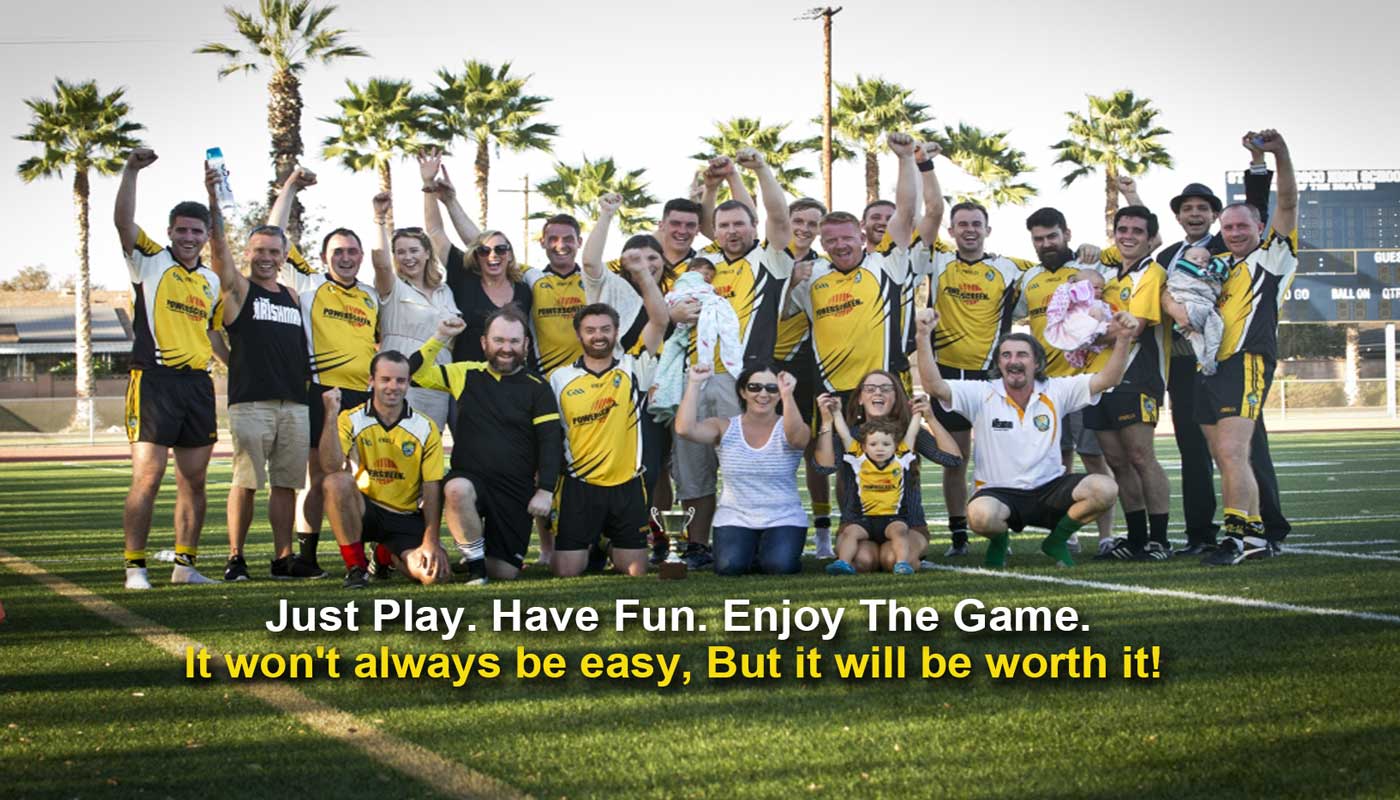
The Wild Geese Gaelic Football Club was founded in 1979 by Romy White (Offaly), Tony Mc Carthy (Clare), Brian Daly (Kerry), Peter Glenane (Galway) and John Wolfe (Kerry) at the Christian Brothers of St. Patrick's in Huntington Beach. Hurling was tried first, but the founders decided to continue as a football club, and that has remained our core identity. Our name echoes a famous chapter of Irish history, which we explore in our article on the Flight of the Wild Geese.
Over the years, the club has drawn players from across Orange County and Los Angeles. At various points we have fielded men's football, men's hurling and, from 2017, a ladies' football team at the West Coast 7s in San Diego. Some of our proudest moments came in 2016, when we won the West Coast 7s and took the Southland Cup Final 3-11 to 2-10. You can read more about our story on our About page.
In the bigger picture, clubs like ours are exactly how Gaelic games have always grown in America: a handful of Irish emigrants find each other, start a team and then open the doors to anyone who wants to play. Today we welcome Irish-born players, Irish-Americans and Americans with no Irish connection at all, and that mix is something we're proud of.
Key Milestones in North American Gaelic Games
Here is a quick timeline of verified milestones in the growth of Gaelic games in North America, along with a few from our own club history.
| Year | Milestone |
|---|---|
| Late 1700s | Gaelic sports played in New York, according to the New York GAA |
| 1884 | Gaelic Athletic Association founded in Thurles, County Tipperary (November 1) |
| 1888 | GAA "American Invasion" tour of the northeastern United States |
| 1914 | New York GAA formed; first New York championship follows in 1915 |
| 1926 | Gaelic Park in the Bronx bought by the GAA of Greater New York |
| 1959 | North American County Board founded (now the USGAA) |
| 1979 | Wild Geese GFC founded in Huntington Beach, Orange County |
| 1987 | Separate Canadian County Board founded (now Gaelic Games Canada) |
| 1991 | Manhattan College takes over Gaelic Park |
| 2004 | First Continental Youth Championships |
| 2005 | College hurling clubs established at Purdue and Stanford |
| 2009 | National Collegiate GAA established by college students |
| 2016 | Wild Geese win the West Coast 7s and the Southland Cup Final |
| 2017 | Wild Geese field a ladies' football team at the West Coast 7s |
Be part of the next chapter
Gaelic games in America have always grown one new player at a time. Whether you're Irish-born, Irish-American or just curious, the Wild Geese would love to welcome you to training in Orange County.
Contact the ClubFrequently Asked Questions
What is the USGAA?
The United States GAA (USGAA) is the governing body for Gaelic games in the United States outside the New York metropolitan area. It was formerly known as the North American County Board, which the GAA lists as founded in 1959, and it is organized into ten regional divisions.
Why does New York have a separate GAA board?
New York has its own long-established association, formed in 1914, with its home ground at Gaelic Park in the Bronx since 1926. It has always been administered separately from the board that runs Gaelic games in the rest of the United States.
When are the USGAA National Finals held?
The National Finals have traditionally been held over Labor Day weekend, although dates vary in some years. The host city changes every year, and recent hosts have included San Francisco and Philadelphia.
Can Americans with no Irish background play Gaelic games?
Absolutely. American-born players are a growing part of the game through youth programs, college teams and adult clubs. Clubs like the Wild Geese welcome complete beginners regardless of background.
Are there college Gaelic football and hurling teams in the US?
Yes. College hurling clubs began appearing in the mid-2000s, and the National Collegiate GAA was established in 2009 to help organize and grow hurling and Gaelic football on campuses across North America.
What is the West Coast 7s?
The West Coast 7s is a seven-a-side Gaelic games tournament held in San Diego over Memorial Day weekend, featuring men's and women's teams in football, hurling and camogie from across the western United States and Canada.
Wild Geese GFC Editorial Team
Written by the players and volunteers of Wild Geese Gaelic Football Club, Orange County’s GAA club since 1979. Questions or corrections? Contact us.